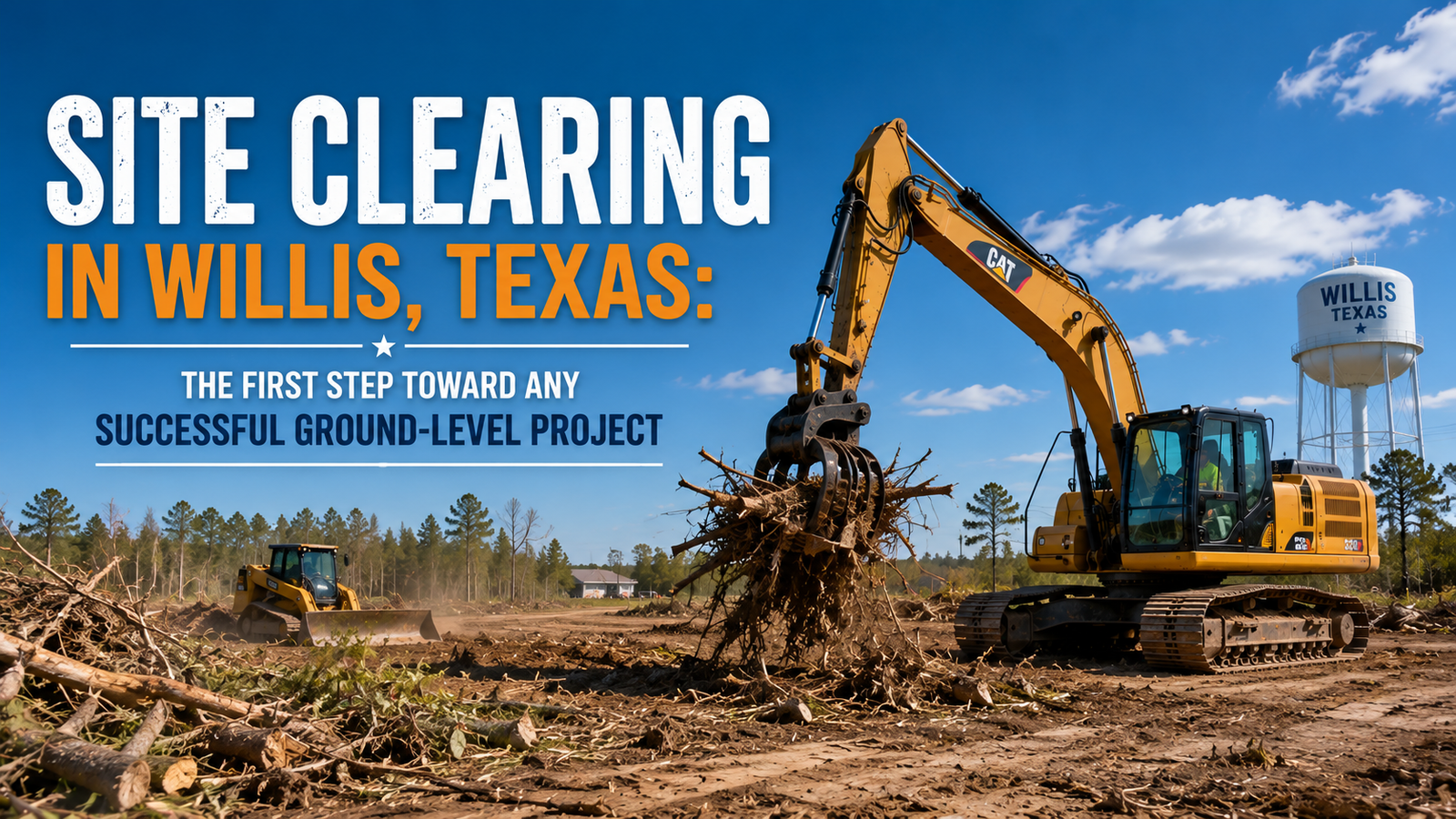
Before any excavator breaks ground on a new construction project, before a foundation can be poured, and before a development site can be graded and shaped, the land itself must be prepared. Site Clearing Willis the systematic removal of trees, stumps, brush, vegetation, debris, and existing surface obstructions from a property is the essential first step that makes every subsequent phase of development possible. In Willis, Texas, where Montgomery County’s active residential growth meets a heavily wooded landscape of loblolly pine, hardwoods, and dense East Texas underbrush, site clearing is a high-demand service that requires the right equipment, experienced operators, and an understanding of the local terrain.
What Site Clearing Involves
Site clearing encompasses all the work necessary to transform a vegetated, overgrown, or debris-covered parcel into a clean, accessible ground surface ready for grading, excavation, and construction. Depending on the existing condition of the property, site clearing may include tree felling and removal, stump grinding or grubbing, brush and undergrowth removal, demolition and removal of existing structures or their remnants, removal of rocks and surface debris, and initial rough grading to establish a workable surface.
The specific scope of site clearing depends on what exists on the property and what the project requires. A raw wooded lot in the Willis area may need comprehensive tree clearing of significant mature loblolly pines and hardwoods, stump removal, brush clearing of dense East Texas underbrush, and rough grading of the cleared surface. A previously developed lot being cleared for redevelopment may primarily need existing structure demolition, concrete removal, and clearing of secondary vegetation that has grown in over time. An agricultural property being converted for residential or commercial use may need clearing of brush lines, hedgerows, and old fencing along with rough grading to establish building pads.
Why Site Clearing Is Particularly Important in the Willis Area
The East Texas piney woods environment that defines much of Montgomery County presents some of the most demanding site clearing conditions in Texas. The region’s loblolly pine forests produce large trees with deep root systems that must be fully removed not just cut at the surface to prevent root decay from creating voids and differential settlement beneath new construction. The understory of these forests is typically dense with brush, shrubs, young trees, and native vegetation that can regrow rapidly if not thoroughly cleared.
Montgomery County’s rainfall consistently among the highest in Texas at around 50 inches annually supports rapid vegetation regrowth. A cleared site that is not promptly graded and either covered or seeded can see significant brush regrowth within a single growing season. This makes scheduling important: site clearing and the subsequent grading and construction phases should be planned so that the cleared site does not sit exposed and unprotected for extended periods.
The clay soil conditions in the Willis area also make complete stump removal particularly important. When stumps and root systems are left in the ground under areas that will be graded and built upon, the organic material decomposes over time creating voids, differential settlement, and potential foundation movement. This is a lesson that experienced Willis-area site contractors emphasize consistently: stumps and root masses must come out of the building footprint completely, not just be cut off at grade.
Site Clearing Methods Used in Willis
Mechanical clearing with tracked excavators is the standard approach for most residential and commercial site clearing in Willis. The excavator’s reach and hydraulic power make it effective at pushing over trees, grubbing stumps from the ground, and collecting and loading debris into piles or directly into hauling trucks. Compact track loaders assist with material loading and cleanup tasks, maneuvering in areas the excavator cannot easily reach.
Forestry mulching using a mulching head attachment on an excavator or dedicated mulching machine is increasingly popular for site clearing in the Willis area. The mulching head shreds trees, brush, and stumps into a layer of wood chip mulch that remains on the ground surface in a single pass. This eliminates the separate debris hauling step required by conventional cut-and-push clearing and leaves a mulch layer that protects the soil surface from erosion. Forestry mulching is particularly well-suited to clearing overgrown properties or brush lines where debris volume would be high with conventional methods.
For large rural tracts in the Montgomery County area north and west of Willis, bulldozers may be used for mass clearing of brush and smaller trees, pushing material into windrows for burning (where burn permits are available) or for subsequent chipping and hauling. Bulldozer clearing is efficient for large, relatively flat areas with moderate vegetation, though it is less precise than excavator work for areas requiring careful stump removal or selective clearing around preserved trees.
Tree Preservation During Site Clearing
Not all trees on a property being cleared for development need to come down. In fact, preserving mature trees particularly where they add landscape character to a residential development or commercial property is often a design priority. Site clearing in Willis sometimes involves selective clearing that removes undesirable or competing trees while carefully preserving specified specimens.
Preserving trees during mechanical site clearing requires deliberate protection measures. Tree protection zones fenced areas around the drip line of trees to be preserved prevent equipment from compacting the soil over root systems, which can kill trees even when the trunk is not damaged. Clearing equipment operators must be experienced in working around protected trees, maintaining the required clearance and avoiding root damage from bucket operations.
The City of Willis and Montgomery County may have ordinances or deed restrictions affecting the removal of certain tree species or sizes. Tree removal permits or approvals may be required in some cases. Local contractors familiar with Willis area regulations can advise on tree preservation requirements before clearing work begins.
After Site Clearing: What Comes Next
A thoroughly cleared site in Willis is ready for the next phase of development work typically rough grading to establish design grades and drainage patterns, followed by excavation for utilities and foundations. The quality of the site clearing directly affects the quality of the grading: if stumps, root masses, or debris are left in the soil, they create interference with grading equipment and complications for later earthwork.
Erosion control is an immediate post-clearing requirement. Once the vegetative cover is removed and the soil is exposed, the site is vulnerable to erosion from rainfall and Willis’s rainfall patterns mean that significant storm events are never far away. Silt fence along the site perimeter, temporary mulch on disturbed soil surfaces, and rock pads at equipment entry points are standard erosion control practices for cleared sites waiting to begin the next construction phase.
Common Questions About Site Clearing in Willis
Does site clearing require a permit in Willis? Permit requirements depend on the scope and the specific activity. Tree removal, grading, and excavation associated with a construction project are typically covered under the building or demolition permit for that project. Standalone site clearing not associated with an active permitted construction project may have different requirements. Texas 811 notification is required before any ground disturbance, and TCEQ stormwater permit requirements apply to sites above certain acreage thresholds.
Can cleared trees and brush be burned on site in Willis? In the semi-rural and rural areas around Willis, open burning of cleared vegetation may be permitted under Texas Forest Service or local authority burn permits when conditions allow. This reduces hauling requirements significantly. Urban and suburban areas of Willis may have restrictions on open burning. Confirm current burning rules before planning on-site burning as a debris management strategy.
How long does site clearing take in Willis? Duration depends on the size of the area, the density and size of vegetation, equipment type, and site access. A typical residential lot of one-quarter to one-half acre in the Willis area might be cleared in a single day with appropriate equipment. Larger rural tracts may take several days to a week or more depending on vegetation density and terrain.